
Story of Chromdiopsid
CHROMDIOPSIDE
Type: diopside
Mohs hardness scale: 5.5–6.5
Color: shades of green
ORIGIN AND PROVENANCE
The name of this mineral comes from Greek and consists of two words, *dio/dis* and *ópsis*, meaning “two faces” or “two perspectives.”
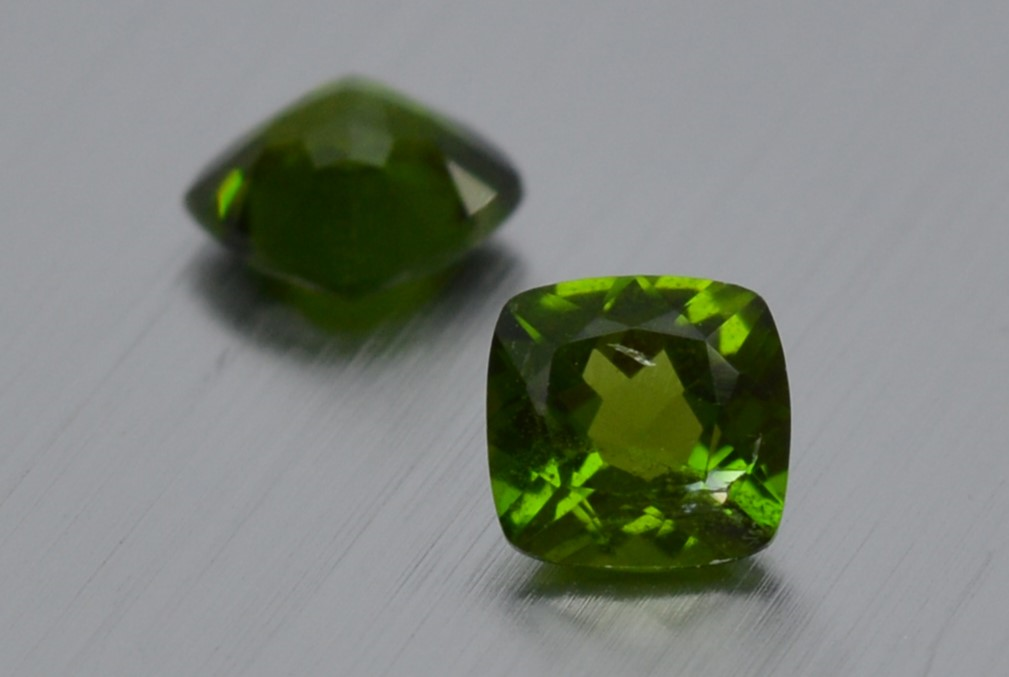
Chrome diopside is a variety of diopside with an emerald-green color, which, as the name suggests, is caused by chromium.
Because of this color, it is also nicknamed the “Siberian/Russian emerald.” It is mined in Siberia, particularly in Yakutsk.
Other types of diopside include fassait (which contains iron and calcium) and violan (which contains manganese).
A special variety is black diopside, also known as star diopside, which exhibits a silver four-pointed star effect.
COLOR
Chromium diopside occurs in nearly every shade of green. Its light green color is similar to that of peridot (olivine); its deep green color can easily be mistaken for tsavorite or green tourmaline; while its emerald green color can rival that of an emerald.
Chromium diopside weighing up to two carats exhibits the most beautiful color tones. If they are larger, the color changes to dark green or black.
Another significant advantage of smaller stones is their greater transparency, which decreases as the mineral’s size increases.
OCCURRENCE
Russia (chrome diopside), Italy (colorless diopside), Pakistan.
USES
Chrome diopside is used in the jewelry industry due to its emerald color and its
color and lower purchase price (compared to emerald). Due to its brittleness (5.5–6.5 on the Mohs scale), it can be easily scratched; therefore, chromium diopside is not suitable for everyday wear.
Chromium diopside can be used in ceramics, glass manufacturing, and fuel cell technology.
Chromium diopside, along with pyrope and olivine (collectively known as KIM—kimberlite mineral indicators, the rock in which diamonds are found), is used to indicate the presence of diamonds based on the composition of major elements and thermobarometric calculations.