
Story of Tourmaline
TOURMALINE
Type: Minerals
Mohs hardness scale: 7–7.5
Color: blue, red, pink, green, black, yellow, orange
ORIGIN AND PROVENANCE
Tourmaline is the name given to a group of borosilicate minerals.
These minerals share a common crystal structure and similar physical properties, but differ in their chemical composition.
TYPES
There are five groups of tourmalines, classified by their trace elements.
Elbaites are colored tourmalines composed of sodium, lithium, aluminum, and sometimes copper.
This group, which includes most gemstones, comprises rubellite, a tourmaline
with a beautiful red color; indigolite, a dark blue-green tourmaline mined in Afghanistan;
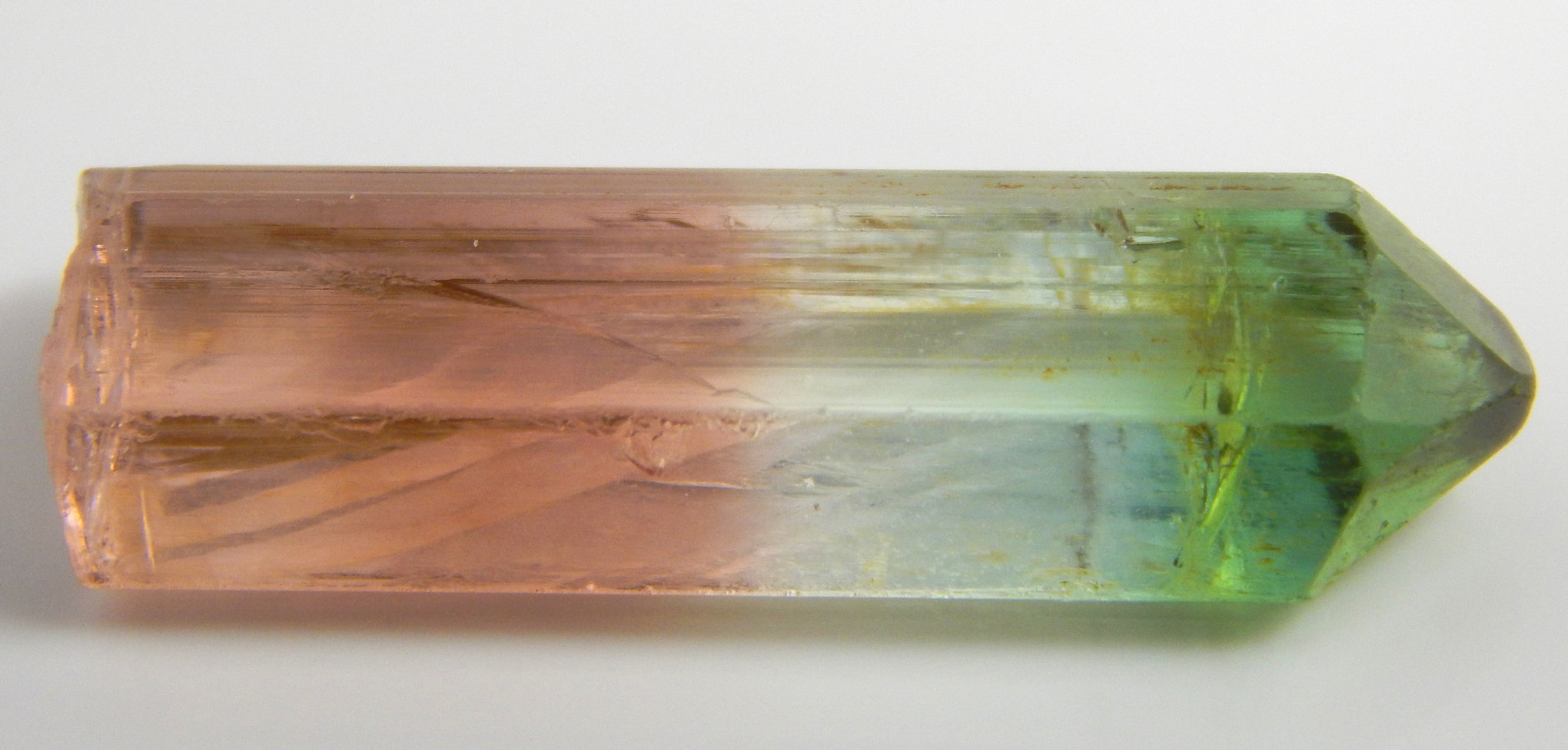
verdelite, with a beautiful light green color. Watermelon tourmaline has a green-red color (reminiscent of a watermelon). This group also includes achroite, olenite, and rossmanite.
The most valuable tourmaline is Paraiba tourmaline, which until recently was mined at only one location in the world—the Paraiba Mountains in Brazil, where it was discovered in 1989. At the beginning of the 21st century, Paraiba tourmaline was also discovered in Nigeria and Mozambique. However, “genuine” Paraiba from Brazil is much more expensive on the market because it has a characteristic neon-turquoise color that is unparalleled in the mineral world. This is due to impurities of copper and manganese.
Dravites occur in dolomites and marbles. They contain sodium, magnesium, and aluminum. These include, in particular, dravite, chromodravite/chrometurmoline, and vanad-dravite.
Uvites contain the trace elements calcium, magnesium, and aluminum, which are found in limestones and dolomites.
These include uvit, savanite, and feruvite.
Slag minerals are usually black in color and occur in various types of rocks. They contain the trace elements sodium and iron. These include slag, bürgerite, foit, magnesiophyte, and povondraite.
The final members of this group are liddicoatites, which consist of calcium, lithium, and aluminum. They occur in granites.
OCCURRENCE
Brazil, Mozambique, Nigeria
USES
Tourmaline is widely used in electrical engineering, such as in the manufacture of hair straighteners.
It is very popular in jewelry, especially watermelon tourmaline and Paraiba tourmaline, whose top-quality varieties exceed the price of diamonds.