Story of quartz
Type: quartz
Mohs hardness scale: 7
Color: variable
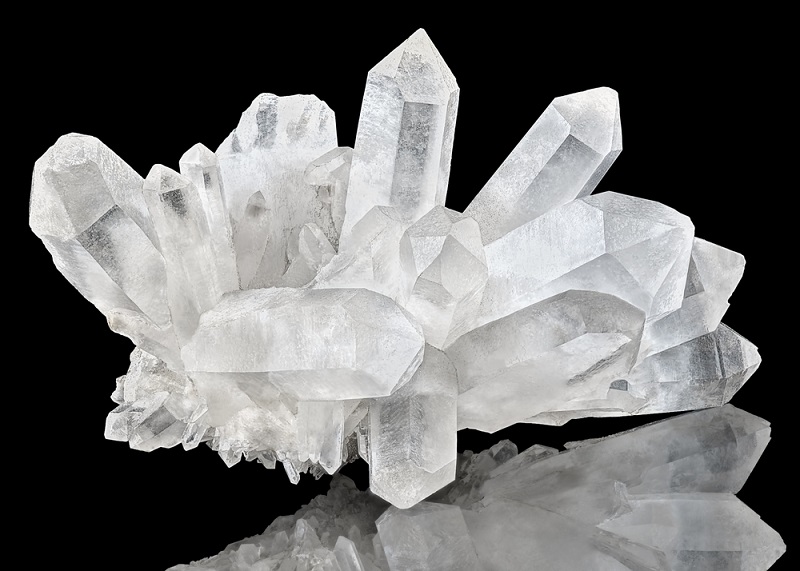
Quartz is a mineral with the chemical formula SiO₂ (silicon dioxide) that is abundant in the lithosphere, where it is one of the most important minerals.
There are many varieties of quartz, including star quartz, clear crystal, rose quartz, brown or smoky quartz, cryptocrystalline chalcedony, banded agate, onyx, purple amethyst, tiger’s eye, ironstone, jasper, yellow citrine, black morion, green prase, and other varieties.
The English term “quartz” derives from the German “quarz” or “twarc” and the Slavic “twardy,” which means “hard.”
Quartz forms from magma as the final stage in Bowen’s reaction sequence.
Quartz is mined in large quantities as a component of sand and gravel and is often used for special foundry or glass-making sands. In addition, quartzites—rocks composed primarily of quartz—can also be mined. Very pure quartz without impurities is obtained from certain quartz veins and the quartz cores of pegmatites.
Thanks to its piezoelectric properties, synthetic quartz is often used as an oscillator in radio technology and other electronic devices, such as watches and other instruments. Its advantage in this regard is that the piezoelectric coefficient is very insensitive to temperature.