The Story of Agate
AGATE
Type: Quartz
Mohs hardness: 6.5–7
Color: White, gray, blue, pink, red
ORIGIN AND PROVENANCE
Agate is one of the oldest and most well-known minerals in the world and was considered the most popular stone of ancient times.
Its name comes from the ancient river Achates in Sicily, where it was first discovered.
Agate is a variety of chalcedony that forms during volcanic processes when quartz precipitates from hot solutions. These eventually fill cavities in volcanic rock, leading to the creation of quartz.
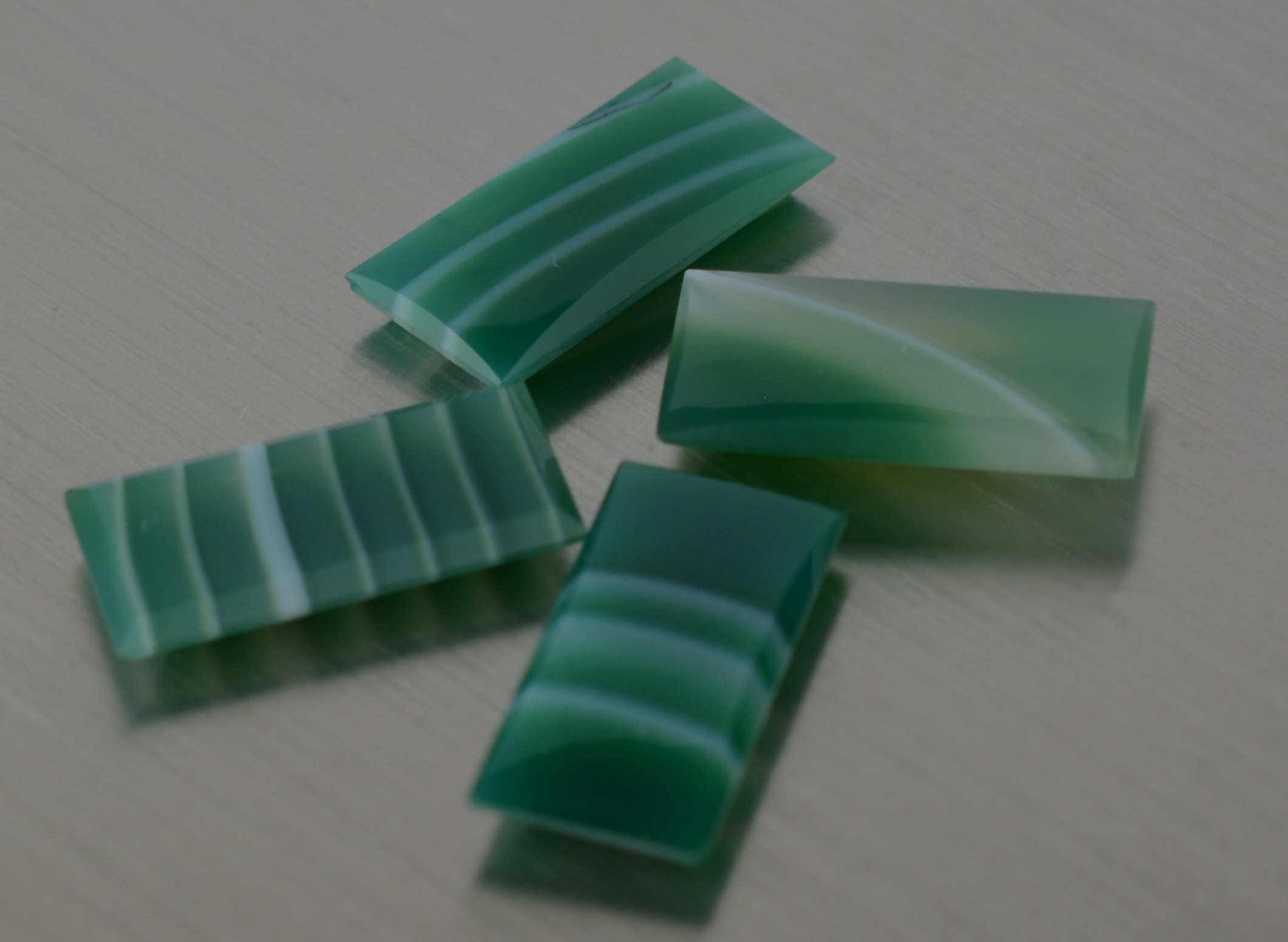
Essentially, agate is a mixture of quartz, chalcedony, and opal. This composition gives it the characteristic banding, which becomes visible only after the stone is cut and polished.
Agate owes its great diversity to the different conditions under which it formed. For this reason, there are many varieties that differ not only in color but also in pattern and shape.
VARIETIES
-
Dendritic Agate
-
Hard Agate
-
Natural (Landscape) Agate
-
Ochre Agate
-
Banded Agate
-
Coral Agate
-
Fire Agate
-
Botswana Agate
-
Moss Agate
ORIGIN
Agates are found all over the world. The largest deposits are in Brazil and Uruguay.
They can also be found in China, Africa, Mexico, and Europe. In the Czech Republic, known deposits are located in the Ore Mountains (Horní Halže) and the foothills of the Krkonoše Mountains (Morcinov near Jičín, Doubravice).
USES
As mentioned, the mining and use of agate date back to ancient times, when this mineral was widely used to make jewelry, decorative objects, and tools.
Even today, agate remains popular in jewelry making, but due to its mechanical durability, it is also used in industry and technology. For example, agate is used to make instrument bearings, laboratory reamers and pestles, scale knife edges, and many other precision components.