Story of Zirconia
Type: Minerals
Mohs hardness scale: 6–7.5
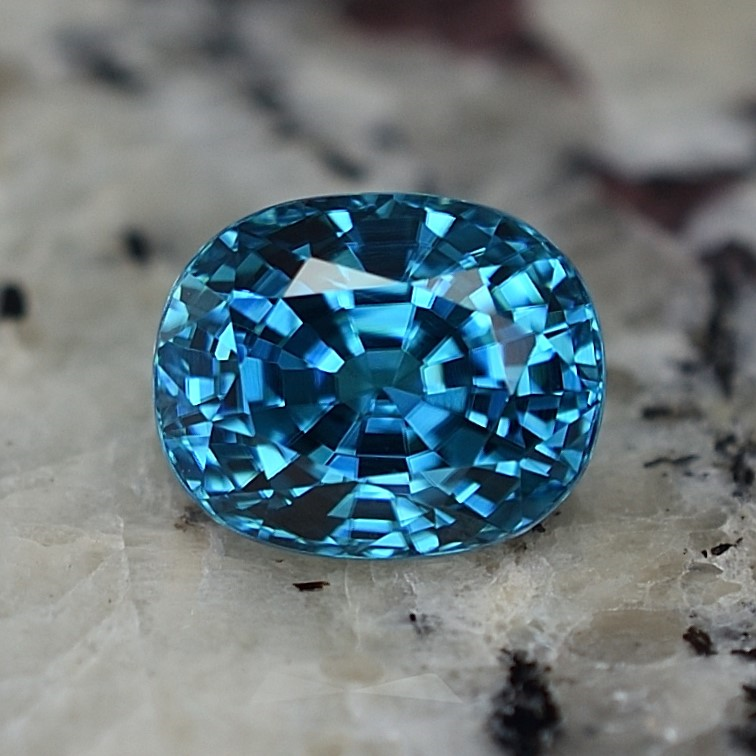
Color: yellow, orange, red, white, blue, green
ORIGIN AND PROVENANCE
Zircon is a natural mineral that is often confused with laboratory-grown cubic zirconia (CZ).
Chemically, it is zirconium silicate.
The oldest mineral on Earth is zircon, which was found in Jack Hills, Australia, and is estimated to be 4.4 billion years old.
The most common color of zircon is blue. Almost all blue zircons have been heat-treated to achieve their color.
Green zircon, the least common in nature, also contains radioactive elements that have disrupted its crystalline structure over the millennia. Based on properties that are directly influenced by the amount of radiation in the mineral, zircons are classified into three grades: high, medium, and low.
High- or normal-grade zircons have a crystalline structure with little or no damage from radioactive elements and are the most common in the jewelry industry. Medium-grade zircons have a crystalline structure with significant damage from radioactive elements. Low-grade zircons have a severely damaged structure and, in extreme cases, are amorphous—that is, they no longer have a crystalline structure. Interestingly, this deformation can be corrected by heating the mineral to a high temperature.
Zircon has a high index of dispersion and refraction, making it an alternative to diamond. However, zircon is many times rarer than diamond!
The biggest difference between zircon and diamond, aside from price, is double refraction. While diamonds do not exhibit double refraction, zircons exhibit it to a great extent, so cutters must be particularly careful when cutting them to prevent the stone from appearing blurry.
Hyacinth is a transparent reddish-brown zircon. "Jargon," on the other hand, is the term for a light yellow to colorless zircon. Starlite is a light greenish-blue zircon that is often heat-treated (Cambodia).
ORIGIN
Cambodia, Madagascar, Myanmar, Sri Lanka, Australia, Thailand
USES
Gem-quality zircons are characterized by their luster and wide color spectrum. They are also used in the ceramics industry.
They are also important for the chemical extraction of zircon and are used in the manufacture of refractory stones.