
Story of Synthetic Corundum
Category: corundum
Mohs hardness scale: 9.0
Color: Colorless, gray, golden brown, brown; violet, pink to red, orange, yellow, green, blue, violet; may be zoned in color, with gray and brown being the most common
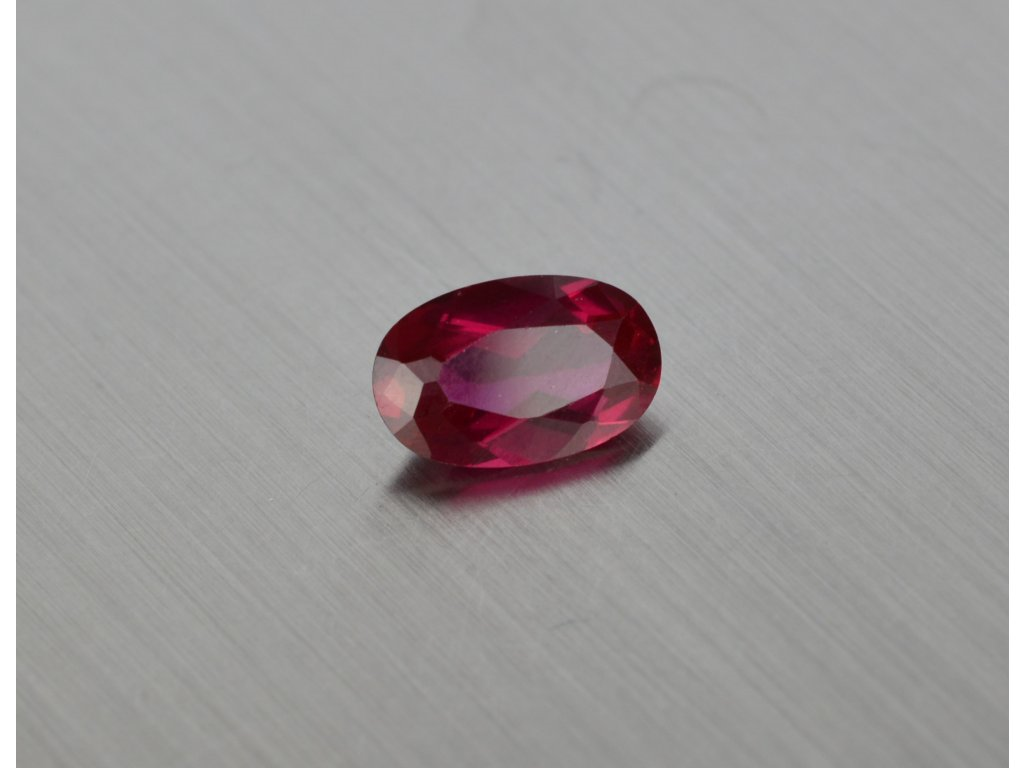
Ruby was the very first man-made mineral.
Synthetic ruby was produced in 1891 using the flame fusion method by the French chemist A. Verneuil, who did not publish his work until 1902, however.
In 1960, synthetic ruby was used to manufacture the first laser.
Synthetic sapphire can be produced in two ways. Either through flame fusion—the Verneuil method—in which a flame melts aluminum oxide powder, the primary chemical component of corundum. The droplets of this mixture are shaped into an elongated teardrop. If other minerals are added to the aluminum oxide, colored varieties of sapphire are produced. However, adding chromium results in a synthetic ruby. This method is the oldest and cheapest, which is why it is still used today.
The second method for producing synthetic sapphire is the so-called Czochralski process. In this process, the alumina is melted using radio waves, and a rod with an embryonic crystal is inserted into the mixture and slowly rotated and pulled to form a column of sapphire. This is a relatively expensive but fast production method.
Synthetic ruby can be produced using the methods mentioned above, as well as through other processes.
In particular, hydrothermal synthesis, which closely mimics the natural formation of the mineral
by subjecting it to intense heat and high pressure in a “pressure cooker.” This is the most expensive method for producing a synthetic mineral.
In the flux method, the corundum additives are dissolved in a mixture that slowly cools and crystallizes.
For most gemstones, laboratories keep the exact details of the manufacturing process strictly confidential as proprietary know-how.
USES
Up to 75% of synthetic rubies are used in industry. Rubies produced by flame fusion (the Verneuil method) are the cheapest and therefore the most economical to produce. Rubies produced using the Czochralski method are mainly used in the manufacture of lasers and have a wide range of industrial applications. Rubies produced using the flux method, on the other hand, are primarily found in jewelry.
In addition, synthetic ruby is used to manufacture small parts for watches, compasses, and electric meters. Synthetic sapphire is found in scanners for POS systems (barcode scanners).