
Story of spinel
Type: Spinel
Mohs hardness scale: 8
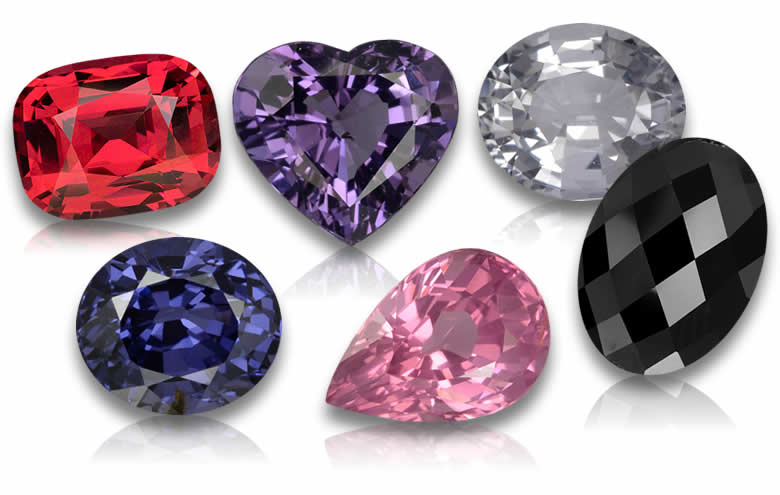
Color: green, gray, yellow, orange, red, blue, purple, black, white, colorless
ORIGIN AND PROVENANCE
For more than a thousand years, spinel has been mistaken for ruby and sapphire. The most famous spinel ever mistaken for a ruby—the Prince’s Black Ruby—forms the centerpiece of the British Crown Jewels. This spinel weighs 170 carats and is the largest uncut spinel in the world.
The Timur Ruby, weighing 361 carats, is the largest uncut spinel and is also part of the British Crown Jewels.
The largest cut spinel weighs at least 400 carats and is set in the Russian Imperial Crown Jewels.
The Crown Jewels, particularly in the crown of Catherine II the Great.
Spinels are rarer in nature than rubies, but rubies are many times more expensive.
COLOR
Spinel is one of the few gemstones that occurs in almost every color.
The most sought-after color of spinel is red. Perhaps because it is almost indistinguishable from a ruby.
Another highly sought-after and rare color is cobalt blue, especially when the spinel is larger than 2 carats.
Star spinel contains rutile needles that form a six-pointed star and is cut into a cabochon shape.
Spinel is characterized by an amazing luster, surpassed only by diamond, sphene, and zircon.
ORIGIN
Sri Lanka, Myanmar (Mogok), Thailand, Vietnam, Afghanistan, Tanzania, Africa, Australia.
USES
Spinel is primarily used as a gemstone in jewelry. Unfortunately, it remains “unknown” and overlooked by the general public.
Spinel has excellent durability; it is both hard and strong, which means nothing can scratch or break it. Thanks to its variety of colors, durability, luster, and affordability, spinel is an excellent choice for incorporation into any piece of jewelry.