
Story of the Moonstone
Type: feldspar
Mohs hardness scale: 6–6.5
Color: white, brown, peach, gray
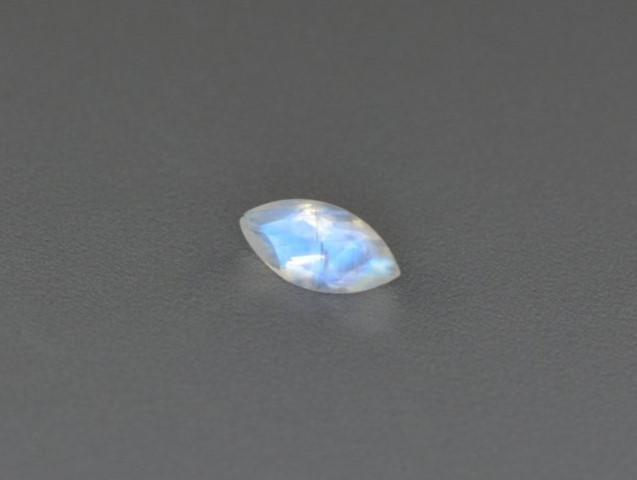
Moonstone is a variety of feldspar and consists of orthoclase and albite. The name of this mineral comes from its iridescent sheen, which resembles moonlight.
The name Adularia—or Adularia, as it is also sometimes called—was derived from Mount Adular in the Swiss Alps, where it was first discovered.
Moonstone was designated the official state gemstone of Florida in 1970 (the same year that Apollo 11 launched from Florida to the Moon).
COLOR
Moonstone exhibits an optical phenomenon called adularescence, which occurs only in the presence of light. This is caused by alternating layers within the mineral, which produce a blue sheen on the surface.
Some moonstones, particularly those from Sri Lanka and India, often contain small amounts of other minerals, such as zircon, garnet, or tourmaline. The composition and structure of moonstone
can influence its color; blue and gray stones contain a higher proportion of albite, while peach and pink stones contain more orthoclase.
ORIGIN
Armenia, Burma, Sri Lanka, India, the United States, Brazil, Australia, Africa
Historically, the most beautiful moonstones with the most intense blue sheen have come from Myanmar (Burma). Most moonstones available on the market today come from Sri Lanka.
USES
Moonstone is used primarily in jewelry, where it is cut into cabochons or, in the case of high-quality stones with a bright blue sheen, into faceted stones.
One of the most popular moonstones today is the Iris Moonstone necklace (winner of the 2017 Gem Trade Association Award), which features a marquise-cut center stone with a unique cat’s eye effect.
In the early 20th century, during the Art Nouveau period, the moonstone was made famous by the French jeweler René Lalique, who loved to incorporate it into his jewelry.