
Story of Kyanite
Type: Minerals
Mohs hardness scale: 5.5–6
Color: blue, white, gray, green
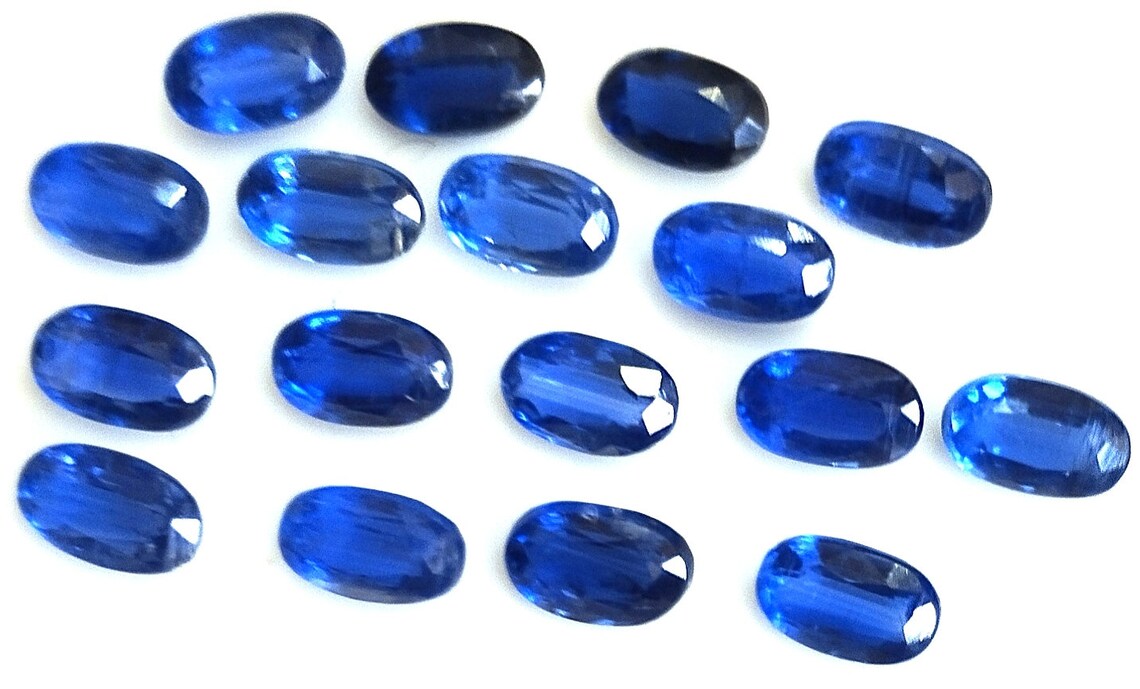
The name “kyanite” is derived from the Greek word *kyanos*, which means “blue.” Chemically, it is an aluminum silicate. Kyanite occurs naturally as a component of metamorphic rocks and is also found in granular aggregates.
Kyanite was discovered in 1789 by the German mineralogist A. G. Werner. The name “Disten,” under which kyanite is also known, was given to it by the French mineralogist Haüy and means “double strength.”
This is because kyanite is characterized by two different hardness values: 4.5–5 on the Mohs scale of hardness along its horizontal axis and 6.5–7 along its vertical axis.
This property of crystals is called anisotropy. Of all gemstones, kyanite is the most anisotropic.
When heated, kyanite can even double in size.
COLOR
In nature, kyanite occurs in light blue, gray, and even green hues. The most valuable kyanite is sapphire blue. Colorless kyanite, on the other hand, is the rarest.
ORIGIN
Tanzania (where orange-colored kyanite occurs due to manganese impurities), Nepal (sapphire-blue kyanite), Cambodia, Brazil, the Czech Republic (Tábor, Kutná Hora, Bečov nad Teplou), Slovakia (Zlatníky, Brezno), the United States, and Russia.
USES
Kyanite crystals are very brittle and therefore very difficult to grind.
Due to its brittleness, this mineral is used in industry, particularly in bricks and mortar, but also in electronics, electronic insulators, and abrasives. It is also frequently used in the automotive and railway industries, where heat resistance is important. Kyanite is also used to manufacture heat-resistant porcelain and ceramics that retain their strength even at very high temperatures. Kyanite is also used to make dentures, sinks, and bathroom accessories.