
Story of Charoite
CHAROITE
Type: silicates
Mohs hardness scale: 5–6
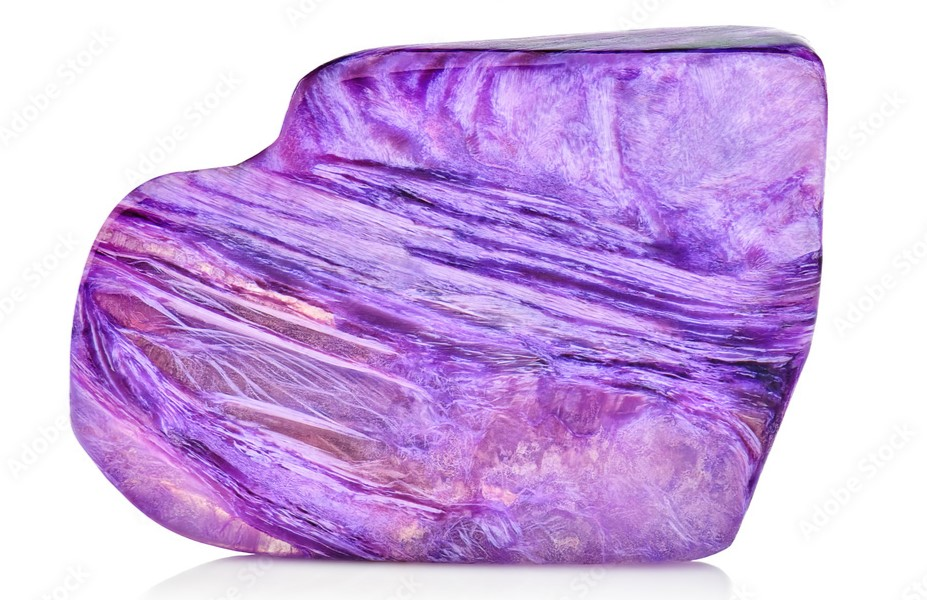
Color: light to dark purple
ORIGIN AND PROVENANCE
There are two theories regarding the etymology of the name of this unknown mineral. According to the first theory, this silicate is named after the Chara River, even though its deposit is located 70 kilometers away from it.
The second view is that the name “charoite” derives from the Russian word “čary,” meaning “magic.” Charoite’s lavender-to-dark-purple color, with white, black, and brown veins, and its pearlescent luster are caused by its high manganese content. However, manganese is not the only element contained in this complex silicate mineral. Charoite contains 40 rare trace elements and minerals,
some of which were still completely unknown at the time of its discovery in the 1940s.
To this day, experts have not reached a consensus on the origin of this purple silicate. Its structure contains several minerals, notably clear quartz and green feldspar. Different sources report varying chemical compositions.
SPECTRUM
There are several types of charoite, depending on which minerals are present within it.
Fuchsite charoite contains small flecks of green fuchsite.
Egirine gives charoite its dark to black color and is almost always present in charoite, as it “grows” with it. Tinaksite, which was discovered at the same time as charoite, is found in charoite in the form of peach-colored flecks.
OCCURRENCE
Currently, charoite is found in only one location in the world. It is located in the Murun Massif in Yakutsk, Siberia, where permafrost predominates. Under these conditions, a maximum of 100 metric tons can be mined annually.
USES
Charoite is usually cut into cabochons and slabs. In Russia, it is also used to make decorative items such as vases, statuettes, and the like. The most sought-after stones in jewelry are transparent charoites with a cat’s eye effect (chatoyance or cat’s eye effect), which are very rare.