
Characteristics of Synthetic Spinel
Variety: spinel
Mohs hardness scale: 8.0
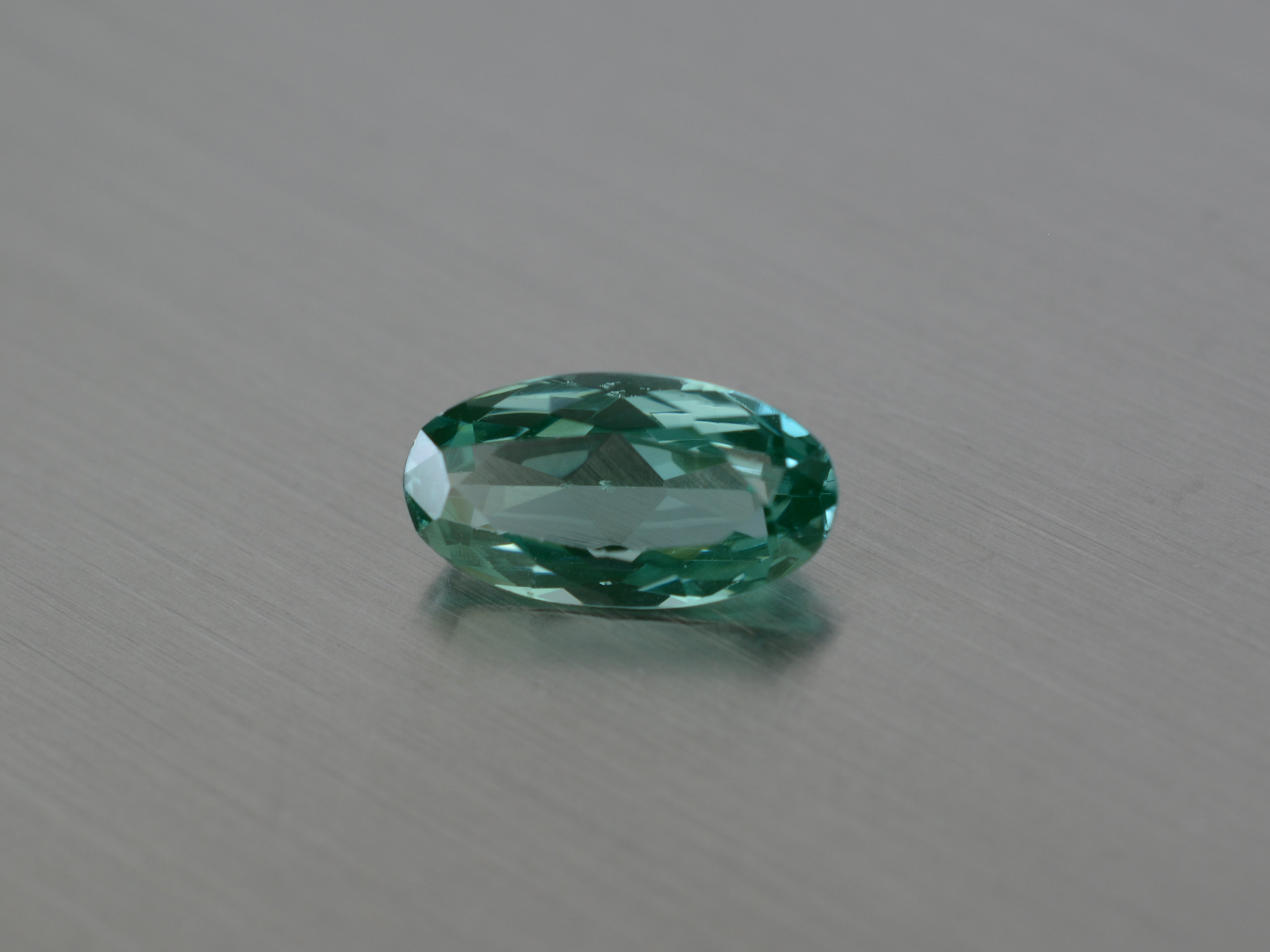
Color: red, pink, blue, lavender/violet, dark green, brown, black, colorless
ORIGIN
Synthetic spinel was discovered by accident during the production of corundum in the mid-nineteenth century (flux process).
It was not until the 1920s that it was produced again as a substitute for light-blue aquamarine in jewelry making (Verneuil method).
The two methods currently used to produce synthetic spinel are the flame fusion or Verneuil method and the flux method (sometimes also referred to as melt-flux).
In the Verneuil method, the raw materials are melted into a powder using an oxyhydrogen flame. This molten liquid mixture falls onto a rotating substrate, where it begins to solidify and forms a crystal as it moves. This is the cheapest and therefore the most common method of spinel production.
In the flux method, the components of the desired substance are dissolved in a solvent. It is a very time-consuming process, as crystal growth can take up to a year. This method is mainly used to produce larger spinels.
The Czochralski process is a method of pulling or drawing from the melt, in which the silicon is first melted and then solidifies into a crystalline state during the process. Unlike the flux method, this process is very fast and easy to control. Using this method, spinels are produced in such a pure form that they resemble glass.
Synthetic spinels can be produced in almost any color except violet. Blue, green, and red spinels are the most commonly produced.
Synthetic spinel differs from natural spinel in that it has a slightly higher refractive index, which is due to a chemical change that has resulted in a higher aluminum content. The blue synthetic spinels produced using the Verneuil process are colored solely with cobalt. They contain no iron and are therefore non-magnetic, another distinguishing feature from natural spinels, which are magnetic due to the addition of chromium.
Synthetic spinels produced using the flux method have a more vivid blue color due to their higher cobalt content and are therefore weakly magnetic.
USES
Light blue synthetic spinel is primarily used as an inexpensive substitute for aquamarine.