
Characteristics of Synthetic Opal
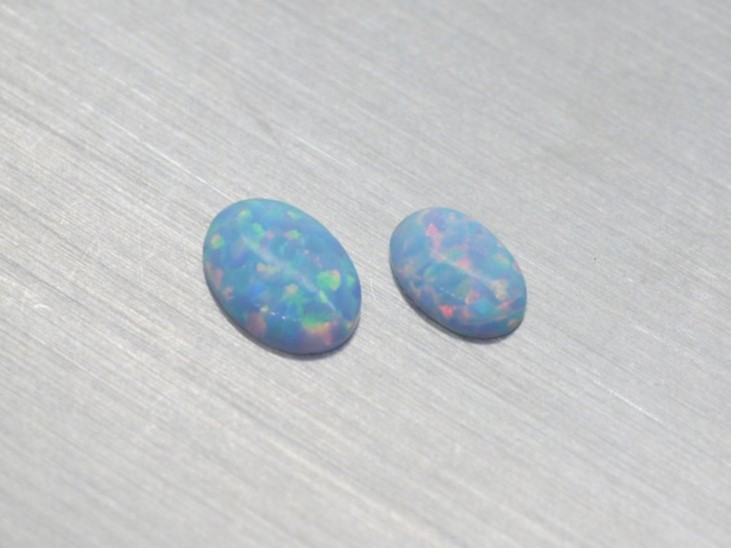
In 1976, Pierre Gilson introduced the first synthetic opal to the market.
Natural opals are divided into two groups: common and rare opals. Rare opals are characterized by their color, known as the “play of color” or opalescence. This group of rare opals is most commonly produced synthetically.
Synthetic opal has almost the same chemical composition, internal structure, physical properties, and appearance as natural opal.
The first synthetic opal was produced by precipitating small, closely packed silicon dioxide particles of uniform size. The space between these particles was then filled with a hardening binder that holds the entire structure together and allows for the refraction of light. This process can take more than a year. In this case, the hardening binder is a polymer resin that does not occur in natural opal.
The manufacturing process for synthetic opal differs significantly from that of other synthetic minerals, not least because opal is amorphous, lacks a regular crystalline structure, and is classified as a mineral gel.
Kyocera, a Japanese multinational ceramics and electronics manufacturer that is also involved in the production of synthetic opal—known as Kyoto opal—manufactures it in traditional Japanese colors, drawing inspiration from the color combinations and designs of Japanese kimonos and gardens.
The synthetic opal known as Mexifire is modeled after a natural fire opal from Mexico. This type of opal does not exhibit opalescence, and, as with natural opal, its orange color is caused by iron elements.
Monarch opal is characterized by its veining and is one of the most successful synthetic opals today.
USES
Synthetic opal is primarily used in jewelry making. Most synthetic opals are cut into cabochons. It is also used as a decorative material and incorporated into home accessories. Like natural opals, synthetic opals can occur in a wide range of colors.